Three Billboards Outside Ebbing Missouri Review New Yorker
[This is a re-post of our3 Billboards Outside Ebbing, Missourireview from the Venice Film Festival. The moving picture opens in limited release on Friday, Nov 10th]
The impeccably titled Three Billboards Exterior Ebbing, Missouri , the new picture show from In Bruges filmmaker Martin McDonagh, is a catalogue of American hatred. Principally, the two-sided hatred of police for protecting their own instead of facing the hatred that oozes within many constabulary stations throughout the country.
McDonagh uses many hateful words toward people of colour, homosexuals, and the police; The Show Me Land is here to testify u.s.a. all sides of hate in Three Billboards. Information technology focuses primarily on 2 characters where hatred of the other side is the basis of their character. Hatred of the police force and hatred of civilians. At that place are a few characters who stand for the gray area in betwixt, who offer olive branches that are only received in one case each of the characters have been humbled. There's a message that the only style to heal the gap between civilians and police in America is to work together equally opposed to each side seeing the other as the opposition. At that place's also the message that the only manner to get through to the "bad apple" policeman is to take their gun and badge without paid leave or severance. These are agreeable messages for anyone who has a centre but Three Billboards but gets there by escalating violence—without nary an arrest on either side—to absurd heights. This is an extremely harsh movie that has some great moments, earns some uncomfortable laughs, but can't complete the tightrope walk because the ii chief forces that have to come together are consummate caricatures of all-consuming grief and all-consuming above-the-police force cop swagger. These aren't characters every bit much as they are, ahem, billboards.
Frances McDormand plays Mildred, a foul-mouthed female parent who is grieving the abduction, rape, and murder of her teenage daughter. The ugly incident happened 7 months prior and the local constabulary have made no arrests. She rents the three titular billboards on a small county road that's generally patrolled by police. In succession they read, "RAPED WHILE DYING," "STILL NO ARRESTS," "WHY, SHERIFF WILLOUGHBY?" They get upward on Easter Sunday and Officer Dixon (Sam Rockwell) is the outset to see them. The immature black man putting up the signs recognizes Dixon from a previous incident and spits at his motorcar.
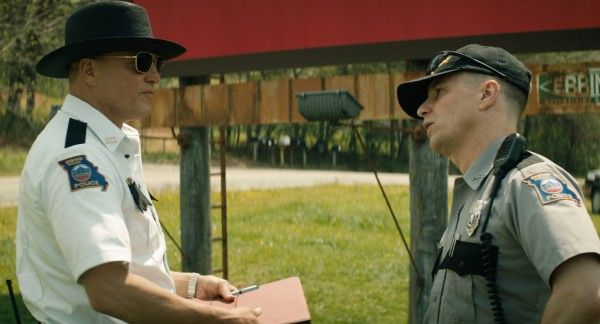
When nosotros get-go meet Sheriff Willoughby (Woody Harrelson) at work, he defends Officer Dixon—a bumbling idiot who can't even continue track of his badge—of his racist reputation by saying, "deep down he'south a good guy." Sheriff Willoughby is actually a adept guy. He fills the gray area in between the oppositional hatred, equally a Sheriff should. He immediately goes to Mildred and explains that they have no Dna matches and no other bear witness, in that location'south very footling that they tin can do at the moment, merely calling attention to the matter could help her case.
Because this is Harrelson and McDormand, two greats at nighttime comedy, at that place are many great scenes between the 2 characters. In fact, the nigh human moment that Mildred has in her unabridged grumpy, crass, one-note role is in the police station with Willoughby. Willoughby has brought Mildred in for questioning because she's been accused of assaulting a dentist with his ain tools after he disparaged her billboards. The Sheriff has pancreatic cancer and is likely in his terminal few months of life. The two merchandise a few friendly barbs when Willoughby accidentally coughs blood on Mildred's face. He looks in horror at the bloody splatter on her forehead and says, "I didn't mean to exercise that." And Mildred, the simply time she lets down her tough act and shows some empathy for someone other than herself, says, "I know" and assists him.
Mildred has a number of monologues that earned applause at the Venice world premiere, for taking on the police, taking on the Catholic church, taking on her ex-hubby (John Hawkes) who beat out her and is at present dating a xix-twelvemonth-old woman (Samara Weaving, unfairly milked for laughs, who as well inexplicably witnesses Mildred placed in a chokehold by her boyfriend with Mildred's son defending her with a pocketknife to his dad's throat and she just asks to use the bathroom; ha ha domestic violence!). Mildred'due south a Greek Chorus of ills, but she'southward no saint. McDonagh includes a vicious flashback where Mildred spars with her girl (Kathryn Newton) over non being able to accept her automobile to a party, the fight ends with the daughter walking off proverb "I hope I go raped on the manner" and Mildred says back "I hope you get raped on the fashion, as well." It's easy to exist in awe of McDormand's gruff presence in Iii Billboards, just to me, she'south a rotten character. Even when her son (Lucas Hedges) pleads with her to take down the billboards because he's existence picked on at school, Mildred brushes off his every concern. She has no empathy for anyone. Only hatred. I can't applaud her monologues considering the roots in them are in pure blanket statements of hatred for everyone in those called groups.
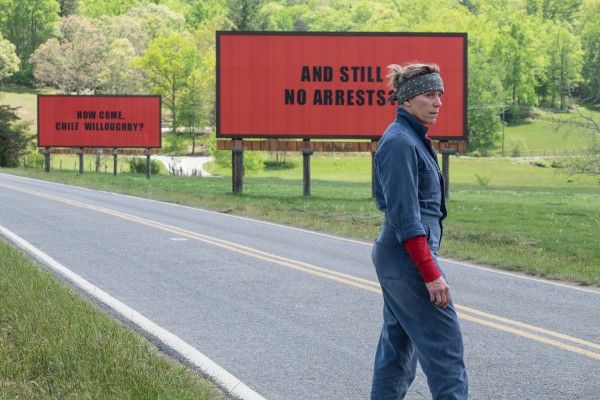
With McDormand as the Greek Chorus for the left side of hatred and Rockwell the bumbling bumper sticker for the right side of hatred, it's unfortunate that Harrelson's Sheriff is eventually reduced to a deus ex machina grapheme. He writes a alphabetic character to each of them that begins a bridge. For Mildred, he says he'll pay for the billboards to stay up past his oncoming death if the case remains unsolved. For Dixon, he says he'd go a adept cop if he could only permit go of his hatred and exist a good person. Of grade, Mildred and Dixon have more clashes and they escalate into ridiculous violence, but Sheriff Willoughby has provided them with the keys that volition allow them to work together to notice justice for her daughter.
McDonagh has other side characters whose presence is simply to quell the burning hate. Caleb Landy Jones every bit the advertiser who sells the billboards to Mildred and Peter Dinklage as a local man who seems to have an inexplicable vanquish on Mildred despite her always walking around dour, adding violence to the customs, and nary even giving him a glance. But they'll each be there at the correct fourth dimension to show Mildred and Dixon the errors of their ways.
McDormand tin can play an ox the whole manner through and McDonagh is aware that he can brand her extremely harsh considering virtually of the audition will be on her side considering she's a female parent who's lost her daughter. Only because Dixon is played by Rockwell at that place'south always an uncomfortable attempt to make Dixon likeable even when he'due south doing horrific things. And his plot device shift toward being a better person doesn't feel earned and then much as it is pushing the same agenda of working together into motion.
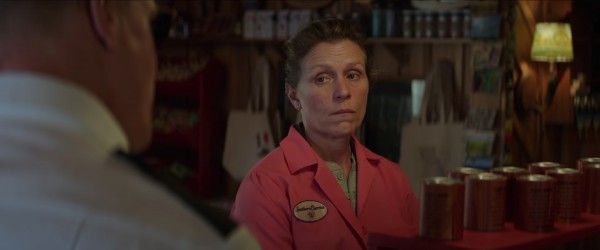
The lesson in3 Billboardsis amusing and the bandage is stacked. But everyone, with the exception of the grayness area that Harrelson's grapheme occupies, is cardboard. And so besides are the tense talking points that pepper in strings of vulgarities merely don't reach a Quentin Tarantino or Coen Brothers' level of character illumination. It's an already emotionally savage pic with fifty-fifty harsher edges and lazy plotting.
For many, these criticisms won't matter because there are moments of nighttime humor that indeed land with some bite. And the whole movie has a bombastic barnburner free energy. But the ludicrous and unpunished escalation of violence and circumstantially easy plot and character devices are far as well many to overcome for me. Because McDonagh's narrative is rooted so deeply in hateful one-notation characters there'southward a singled-out lack of humility that makes most dark comedies hum.
Grade: C
About The Author
Source: https://collider.com/three-billboards-outside-ebbing-missouri-review/
0 Response to "Three Billboards Outside Ebbing Missouri Review New Yorker"
Post a Comment